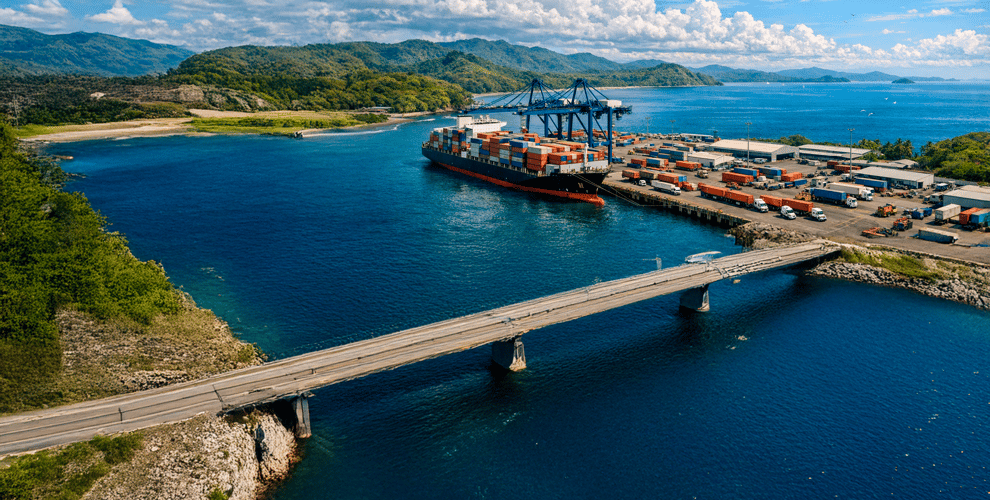


Multimodal logistics in Central America is no longer a contingency plan — it is increasingly a strategic routing tool.
Freight forwarders shipping from China into the region often begin with a single-mode plan (ocean or air). But real operating conditions — port congestion, feeder delays, customs bottlenecks, inland disruption — frequently make multimodal solutions faster, safer, or more cost-efficient.
In Central America, combining ocean + air + ground is not an exception scenario. It is a practical execution model when designed with regional operational control. Forwarders who understand when to activate multimodal routing gain a competitive advantage in transit reliability.
What Multimodal Means in the Central America Context
Multimodal logistics in the region typically combines two or more of the following:
- Ocean + ground cross-border
- Ocean + short-sea + ground
- Ocean + air (sea–air model)
- Air + ground regional distribution
- Hub arrival + inland redistribution
- Alternate port arrival + trucking to destination country
Because Central America countries are geographically connected by land corridors, multimodal routing is often operationally viable — when properly planned.
Why Multimodal Is Growing in Central America
Several structural realities are driving multimodal growth:
- Periodic port congestion cycles
- Feeder schedule variability
- Limited direct service frequency to some countries
- Regional hub dependency
- Border infrastructure improvements
- Better cross-border trucking networks
- Increased demand for transit reliability
- Higher value and time-sensitive cargo flows
Forwarders are shifting from “single-lane routing” to adaptive routing design.
Scenario: Panama Congestion → Costa Rica Multimodal Adjustment
A common scenario involves cargo arriving through the Panama hub during congestion periods.
Single-mode risk:
- Feeder delay to Costa Rica
- Container rollover
- Hub dwell time increase
- Delivery date uncertainty
Multimodal adjustment:
- Ocean arrival to Panama
- Priority unload
- Ground or priority feeder alternative
- Direct inland transfer to Costa Rica
Result: Reduced waiting time and more predictable delivery window — even if base freight cost increases slightly. Transit reliability often matters more than base rate.
Scenario: Guatemala Arrival → El Salvador Delivery by Ground
Another frequent model: Cargo arrives at a Guatemala port but final delivery is required in El Salvador.
Instead of waiting for a secondary ocean leg:
Multimodal solution:
- Ocean arrival Guatemala
- Customs coordination
- Cross-border trucking to El Salvador
- Regional clearance planning
This model can reduce total transit time and handling events when documentation is pre-aligned.
When Multimodal Reduces Transit Time
Multimodal routing often improves timing when:
- Hub feeders are delayed
- Direct services are infrequent
- Final destination is near a land border
- Port dwell times are rising
- Air uplift is needed for last segment
- Partial shipment acceleration is required
- Split delivery improves business outcome
It allows forwarders to bypass bottlenecks instead of waiting inside them.
When Multimodal Reduces Risk
Risk reduction occurs when multimodal routing:
- Reduces handling transfers
- Avoids congested hubs
- Bypasses unstable feeder lanes
- Shortens storage exposure
- Improves cargo control
- Uses more predictable inland legs
- Enables shipment segmentation
For high-value or sensitive cargo, control can outweigh simplicity.
When Multimodal Reduces Total Logistics Cost
Although multimodal may increase one segment cost, it can reduce total cost by:
- Avoiding port storage charges
- Preventing demurrage and detention
- Reducing delay penalties
- Protecting inventory availability
- Avoiding emergency air freight later
- Reducing rollover risk
- Improving delivery predictability
Total logistics cost is not equal to base freight rate.
Operational Requirements for Successful Multimodal Execution
Multimodal success depends on coordination — not only route design. Forwarders should ensure:
✔ Cross-border documentation alignment
✔ Customs sequencing planning
✔ Inland carrier reliability
✔ Border crossing timing strategy
✔ Cargo visibility across modes
✔ Unified shipment control
✔ Local operations support
✔ Regulatory compatibility across countries
Without regional execution control, multimodal adds complexity instead of value.
Common Multimodal Planning Mistakes
Non-regional forwarders often:
- Activate multimodal too late
- Ignore border clearance timing
- Misalign documents between modes
- Underestimate inland transit variability
- Skip customs pre-coordination
- Treat countries as one regulatory zone
- Lack local ground control
Multimodal must be designed — not improvised.
Multimodal Works Best with Regional Control
Central America multimodal routing performs best when supported by:
- Local customs teams
- Regional trucking networks
- Cross-border expertise
- Gateway flexibility
- Real-time operational visibility
- Country-by-country compliance knowledge
Execution capability is the real differentiator.
Facing port congestion or tight delivery timelines in Central America? Grupo Linc designs multimodal routing strategies based on real regional operating conditions across Costa Rica, Guatemala, El Salvador, Nicaragua, and Panama.
Consult our regional logistics team to build a faster, lower-risk multimodal solution for your China → Central America shipments: